
Where a data center lands changes what a community stands to gain, what it risks and which alternatives deserve consideration.
Not all data centers serve the same purpose or place the same demands on energy, water and infrastructure. But even an identical facility can create very different benefits, costs and risks depending on where it is built. The familiar promises of construction jobs, tax revenue and investment tell us little about the full bargain until we ask where the facility would sit, what else the land could become and who would live with its effects. Not to mention plans for potential decommissioning and downstream power and water infrastructure decisions.
Data Center Neighbor's Fair Share approach asks four questions: Who benefits? Who pays? Who carries risk? And do communities still have meaningful choices? In this article we’ll explore how different the answers can look depending on one consequential decision: where a data center is built.
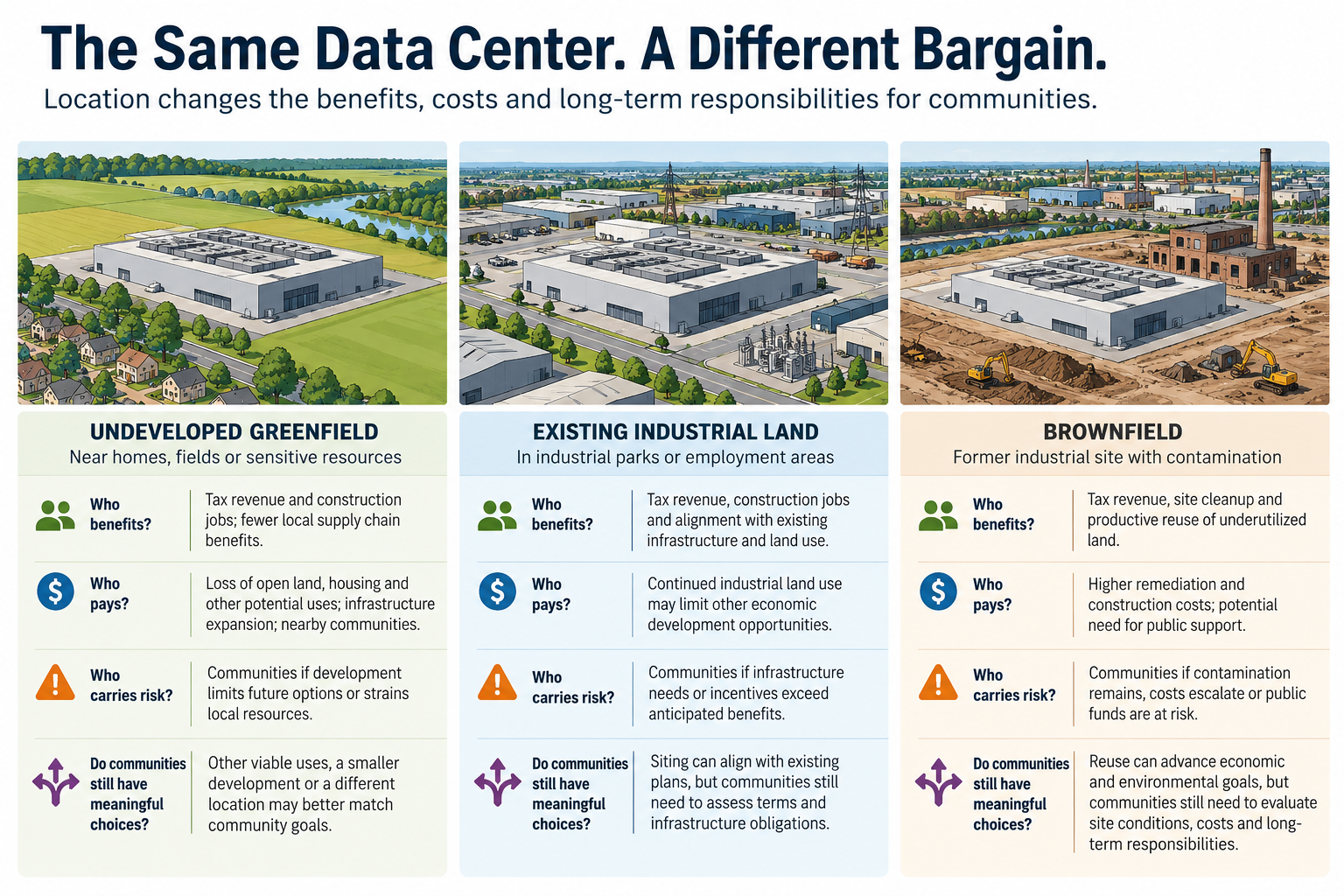
Contested greenfield: what Potential Could be lost?
The promise of substantial tax revenue from data center development can be difficult to match, but land converted to data center use is no longer available for other purposes, including housing, mixed-use development, agriculture or open space. Those alternatives have economic and community value of their own, even when they don't generate comparable tax receipts.
A serious review must consider the site's existing use, other viable uses, a smaller development or a different location. It also needs to trace infrastructure beyond the property line: roads, substations, transmission lines, water systems and noise impacts.
A benefits package can improve project terms, but can’t answer whether the project belongs there.
Existing industrial land: what can actually be reused And Replaced?
Previously developed industrial property may offer a way to accommodate growth with less new land disturbance. It may replace lost economic activity. But an industrial label is not proof of spare grid capacity, adequate water, suitable buildings or distance from homes.
A sound comparison asks what can be reused, what must be rebuilt, what additional infrastructure is required and whether the project would displace another viable use with different jobs or fiscal benefits. The relevant question is not simply whether development is permissible. It is what this particular project adds to an already developed place.
Brownfield or impaired land: who owns the long tail and associated expenses?
A site complicated by contamination may offer an opportunity to finance cleanup alongside productive reuse, which is an attractive consideration. It also demands clarity about site conditions, remediation costs, continuing monitoring and liability if ownership or operations change. EPA's redevelopment guidance stresses community priorities, environmental assessment and realistic reuse planning.
The community should not have to accept an unsuitable new use to secure attention to an old problem. Cleanup and reuse alternatives belong in the comparison, too.
The choice is bigger than the parcel itself
No location is automatically right or preferred. Each presents a different mix of public value, private return, infrastructure demands and long-term obligations. Each should also be accompanied by a different, enforceable Community Benefits Agreement that appropriately addresses costs, benefits and long-term site usage plans. Virginia's JLARC study documents both the substantial fiscal value some localities have realized and siting concerns associated with noise and proximity to residences. [2]
The point of this exercise was not to ultimately rank three site types, but to demonstrate how to apply the Fair Share approach makes the alternatives and considerations visible before a preferred site becomes an assumed outcome.
Understanding these tradeoffs requires communities need independent expertise to evaluate alternatives, challenge assumptions and negotiate terms while meaningful choices remain.
