
What is a “Fair Share?”
In many ways, a data center is a Rorschach test. An economic developer may see investment, tax revenue and new resources for schools and public services. A neighbor may see noise, changing landscapes and land consumed by facilities, substations and transmission lines. A utility sees an enormous new customer, rapid demand growth and the risks that come with planning billions of dollars of infrastructure around uncertain future load. Water and public works systems may be confronting similar questions about capacity, infrastructure and who pays for it. Regulators and ratepayers are asking who should pay for it. Developers are optimizing for speed to market. Policymakers are trying to sift through all of it and decide what serves their constituents.
The Good Neighbor Framework is an attempt to put those competing perspectives into one view by applying four questions:
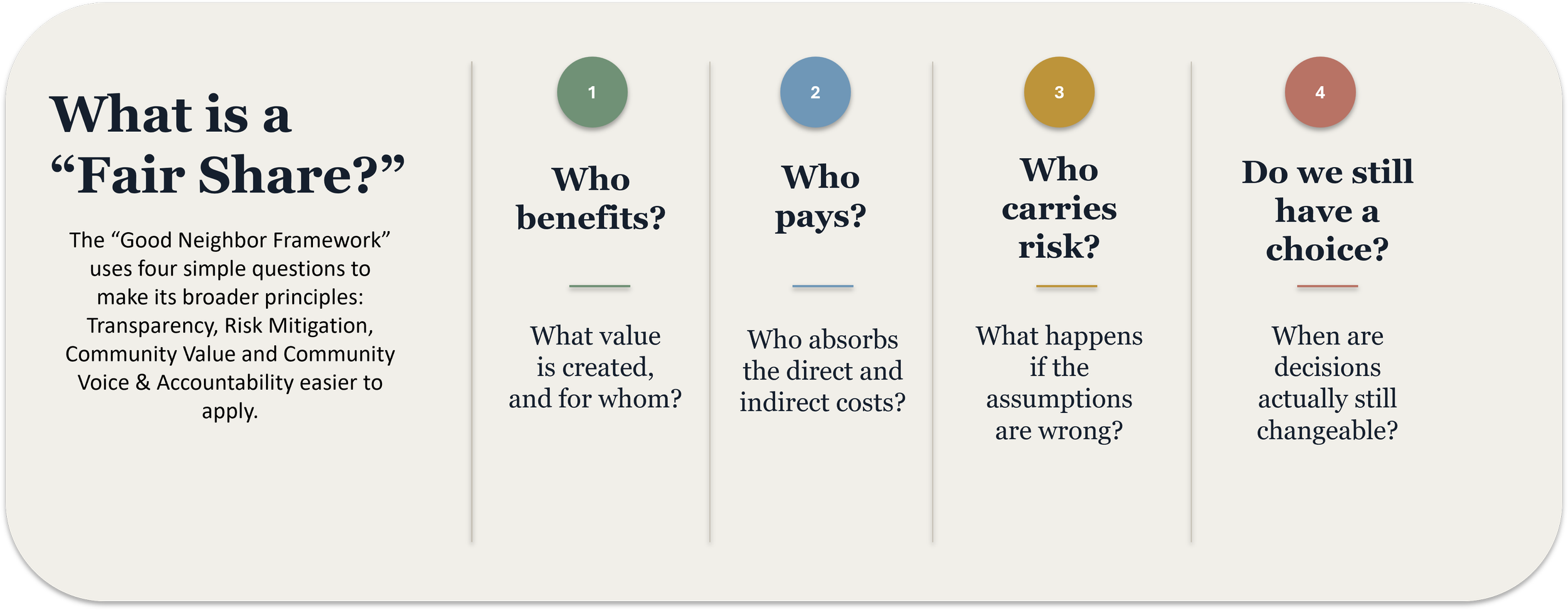
The framework does not assume that every project should proceed, or proceed as scoped. A fair-share analysis may point toward better mitigation or stronger community benefits. It may also point toward a different site, a different scale, a different infrastructure solution or no project at all. The point is to keep those choices open long enough to evaluate them.
Today’s public discourse was not designed to tackle complex multidisciplinary challenges particularly well. Social media manifestos, institutional mandates and specialized regulatory processes tend to pull the issue apart into arguments about jobs, bills, land, power or growth.
Over the past several months, several recognizable lenses have coalesced around the tensions surrounding data centers and communities.
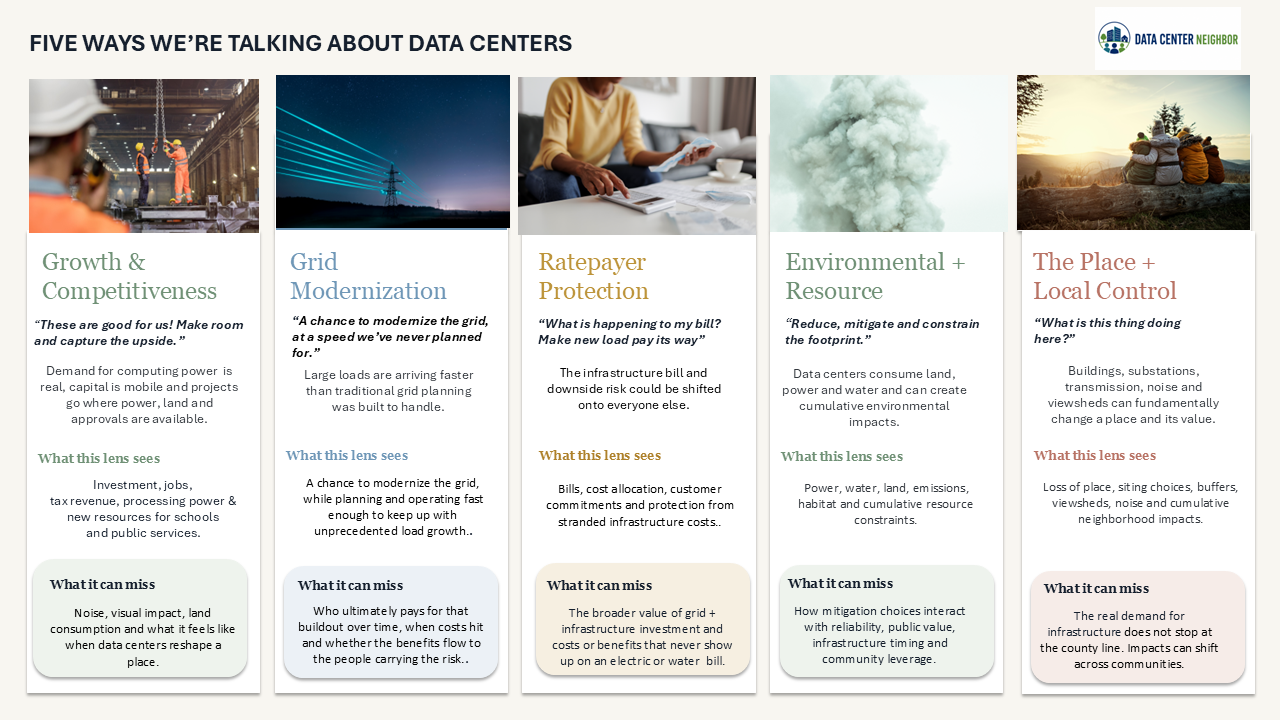
Each lens sees something real. Each can miss part of the bigger picture
The “Growth & Competitiveness” lens focuses on capturing the economic opportunity. The “Grid Modernization” lens sees an urgent grid-planning challenge and an opportunity to modernize the system through new investment and flexible load management. The “Ratepayer Protection” lens asks how the costs and risks of serving large new customers are allocated across electric, water and other public infrastructure systems. “Environmental & Resource” are examining impacts on land, water, energy, emissions, habitat and other finite resources. And communities are asking a much more immediate question about “Place & Local Control”: what is this development doing to the place where I live?
Each lens sees something important, and that is precisely why the debate around “what do we do” is so difficult. The “Growth & Competitiveness” case does not make noise, transmission lines or loss of place disappear. “Grid Modernization” may create broad system value while still leaving hard questions about how quickly infrastructure is built, when costs are incurred and who ultimately carries them. A well-designed utility tariff may address “Ratepayer Protection” without answering what happens to water, wastewater or other public infrastructure costs, much less whether the project is in the right place. “Environmental & Resource” can identify impacts on land, water, energy and habitat without answering the harder question of how much change or resource demand a community should reasonably be expected to absorb.
And, critically, even robust community benefits cannot make every siting decision a good one from the perspective of “Place & Local Control.”
The Good Neighbor Framework is meant to expose where those partial views intersect and where something important is falling through the cracks. It also helps separate feasibility from convenience and cost. A different route, site, buffer or infrastructure design may be technically feasible even if it is more expensive, slower or less convenient for a developer or utility. That does not automatically make it the right choice, but it does change the question from “can this be done?” to “who should absorb the added cost and inconvenience, given who receives the benefits?”
That opens the door to better questions: Could a project be smaller? Farther from homes? Located on already-developed industrial land rather than consuming forest or farmland? Could contaminated land be remediated and reused rather than adding another greenfield site? Could it rely on reclaimed water, lower-water cooling or a site better suited to its water demand? Could transmission be routed differently? Could concentration be reduced?
“Where developers and hyperscalers stand to capture substantial economic value, a fair-share analysis should not assume that the least expensive or fastest option for them is automatically the fairest option for everyone else.”
And sometimes, after weighing the full bargain, the answer may still be no.
What’s next?
In the next Field Notes, we will put the framework to work on real decisions, beginning with siting. We’ll apply the same the framework to three real data center cases with very different conditions: contested greenfield development, redevelopment of former industrial land and development on contaminated property.
One type of site may not always better than another depending on local context. This next step will help us to see whether the framework helps identify materially better choices: where development creates a strong bargain, where the project or infrastructure plan should change, where another site would produce a better outcome and where the evidence points to “no.”
